Friday, July 12, 2013

Review: Wait For You - J. Lynn


Wait For You
J. Lynn
Series: Wait For You, #1
Genre: New Adult, Romance
Rating: 1.5 out of 5 stars
Word Rating: Vomit Inducing
On Goodreads

As a diehard romantic, I am always excited by the prospect of a cheesy, wonderfully sappy, lovey-dovey novel. Regretfully, Wait for You was disappointing in every aspect. This book was, in simplest terms, cringe worthy. My copy of Wait for You was an uncorrected proof from Book Expo America, which I borrowed from Kiersten because “it looks good!”

Unfortunately, I was very very (I cannot stress the “very”s enough) wrong about this. The book contained b-e-a-u-tiful gems such as: “My tummy tumbled.” The main character, Avery Morgansten is skittish and terribly annoying. As aptly said by the blurb, she wants to forget the tragedy that changed her life (I’ll be italicizing words that emphasize said tragedy, because J. Lynn felt that was necessary to foreshadow). I promise you, dear reader, you do not need the italics – instead, within the first 20 pages what the tragedy is will come to you (Trust me. You’ll know. It’s that obvious).

But let us forgive this predictability.

Let us talk about the characters. We have Avery, who is changed by the tragedy, and because of this, she is so very different. But oh no! Not to worry! Just because her personality is such that she is completely antisocial (albeit, for good reason), a great, handsome, funny, caring, charismatic, and completely perfect boy falls in love with her. W H O A. Mind blown. Cam is flawless – he has everything from washboard abs to an understanding attitude and even to the ability to miraculously transform from a player to a monogamous boyfriend. Cam even has the ability to *gasp* wait for Avery (hence the title, Wait for You) for a relationship and sex. Congratulations, Cam, for your overwhelming self control. Cam is completely static - in the entire novel he made exactly one mistake for which he showed an appropriate amount of grief and apology.  Even minor characters such as Jacob and Brittany are ridiculously cliché – Jacob is gay and J. Lynn never lets us forget it, by having his character be the most flamboyantly homosexual guy ever while Brittany is clearly the stereotypical blonde bimbo who needs to get “laid” every other day.

This book has two redeeming aspects, the first of which is a character who rarely appears in the story but nevertheless, is real and hurt and possibly the best thing about the book. Her name is Molly and she is the only character in this book who holds others accountable for their mistakes and owns up to her own; she is sad and disappointed but above all of that, she’s fierce. The second redeeming factor is that J. Lynn tried really hard to make amusing comments such as:
"'I'm beginning to think cookies is a code word for something else.' 'Maybe it is.' He tugged on my bag again as he took a confident step back, forcing me down another step. 'And just think about it. If cookie was a code word, whatever it symbolizes, it's been in your mouth, sweetheart.'"

She really did try.
Sadly, despite these two factors, Wait for You was, in my eyes, a train wreck. Thanks for trying, J. Lynn. But next time, don’t bother. We’ll be able to guess the entire plot line based off of the first twenty pages anyway.

- Amrutha


What makes you dislike a romance?
Let us know in the comments!

Wednesday, July 10, 2013

Review: The Ocean at the End of the Lane - Neil Gaiman


The Ocean at the End of the Lane
Neil Gaiman
Series: N/A
Genre: Fantasy, Paranormal, Magical Realism
Rating: 5 out of 5 stars
Word Rating: Wondrously fantastical
On Goodreads

Neil Gaiman, in this wondrous novel, has proven that the best way to write a novel for adults is through the eyes of a seven year old child. This book is, in its very essence, magical. The writing is fluid and graceful, almost as if the entire novel is a swim through the “ocean” in the title. Gaiman take us through the entire novel without ever naming the main character. Told in first person, the story of what happened on Hempstock farm (and the surrounding area) is recounted anonymously by our narrator, who has stopped by his old house on his way to a funeral. After finishing the book – which was short and took only a few hours – I realized that naming him would have taken away from the surreal and dreamlike nature of the novel.

The Ocean at the End of the Lane was 178 pages of riveting, fantastic charm. The entire novel is a flashback, and as the story progresses, the man’s memory of the incidents get clearer and more detailed. Although, as Old Mrs. Hempstock says, “Different people remember things differently and you’ll not get any two people to remember anything the same, whether they were there or not.” Who’s Old Mrs. Hempstock, you (don’t) ask? She’s one of the three women who live on Hempstock Farm. Old Mrs. Hempstock is so old that she “remember[s] when the moon was made.” As old as she is, however, she is not frail, and she regularly does things that most young, able-bodied people don’t – and not just around the farm, either. Old Mrs. Hempstock saves lives and is as wise and intelligent a she is old. And no one can parallel her in her magic – it’s not every person that can do a seamless “snip and cut” or put an ocean in a bucket. Her daughter, Ginnie Hempstock, also lives on the farm. She’s sweet and motherly, and knows some pretty powerful magic, herself. She thinks on her feet and is full of sass. In fact, our third Hempstock – eleven year old Lettie – must have inherited that from her mother. Lettie is a friend our narrator makes and it is her ocean that exists at the end of the lane. Lettie is headstrong and stubborn, and very wise for an eleven year old girl. She loves to do things on her own, but shows responsibility and knows when there is too much danger. Lettie was by far my favorite character in the novel, because she showed so much imagination and creativity, along with her wit and bravery.

Throughout this novel, our little seven year old dealt with a harsh family, a “content” but not happy lifestyle, and then, one day, an Ursula Monkton. Ursula Monkton was supposed to be a tenant of their house, receiving free room and board in exchange for being a nanny to the kids. However, everything is not as it seems and she turns out to be a much bigger threat than our protagonist bargained for. The novel explores his journey in getting rid of her once and for all, and facing some other enemies along the way.

The Ocean at the End of the Lane is full of Neil Gaiman’s smooth, cohesive language. Who else could think of phrases like “Lettie Hempstock looked like pale silk and candle flames” and “the peculiar crinkling of space on space into dimensions that fold like origami and blossom like strange orchids”? The entire book is full of fluid and wondrous phrases, seamlessly blended into the story, which is captivating in itself. The plot of this novel fits together perfectly and the last bit is like a wrench in the heart – one you never want to remove. The story progresses rapidly enough to keep it interesting, but Gaiman still manages to throw in some ends that you didn’t know were loose until he tied them right up in front of you. Some of my favorite recurring themes weren’t even the major ones, like the narrator’s “little yellow handbasin, just [his] size,” or the way Old Mrs. Hempstock exclaimed “Stuff and nonsense!” in every situation.

This book was full not only of magic and conquering beasts, but of inner turmoil and defeating the beasts that are a little more common. As a seven year old, our boy dealt with much more emotional scarring from his father than normal. He also learned at such a young age that “Books were safer than people, anyway” and chose to spend his time reading than interacting with other children. Lettie Hempstock may very well have been his only friend up until that point. He learned to do things on his own and handle things in a much more mature way than most seven year olds.

Once again, Neil Gaiman has created a dazzling piece of art. His tale about the events set off by the death of an opal miner is an entrancing story, one that can be taken in many different ways. It’s one of those books that you have to read as a child, and then read again as an adult, to fully understand. Or, like me, channel both your inner child and your inner adult at the same time and see what a masterpiece this novel is. This is not just a story of a man who, with one look at an ocean-that-is-really-a-duck-pond (or vice versa), remembers an adventure. This is a story about selflessness and growing up and childishness and love. And it’s been done wonderfully.

- Noor

What's your most vivid childhood memory?
Let us know in the comments!

Thursday, July 4, 2013

Review: Trail of Dead - Melissa F. Olson


Trail of Dead
Melissa F. Olson
Series: Scarlett Bernard, #2
Genre: Urban Fantasy, Paranormal, Mystery
Rating: 4.5 out of 5 stars
Word Rating: Awesome
On Goodreads

After buying Dead Spots as a Kindle Daily Deal and absolutely loving it, I was anxiously awaiting Trail of Dead – with the ending of the first Scarlett Bernard book, it’s a miracle I made it until the release! I wasn't quite as drawn in with this book as I was with its predecessor, but, nonetheless, I was very happy after reading Trail of Dead – with action, mystery, sarcasm, and subtle romance, it did not disappoint!

Scarlett Bernard is a null – someone who can nullify all supernatural beings within her "radius". That means within a certain distance of Scarlett, all vampires and werewolves become human and no witch can cast a spell. I love the mythology of the Scarlett Bernard series largely in part because of nulls. The idea of nulls plays such a huge part in both Dead Spots and Trail of Dead, and Melissa F. Olson does a wonderful job explaining how it works and how nulls play into the larger picture of supernatural society.

*For the sake of keeping this spoiler free for both Dead Spots and Trail of Dead, I will be using “the villain” in place of a particular character’s name.

At the beginning of Trail of Dead, I was anxiously waiting to see what the villain had in store for us, and the mystery was set up almost right away. I loved the way the mystery of this book built because it gave me the sense of the way Scarlett and the other characters were trying to evaluate all the information and figure out what was going on. Another great aspect of this book was the psychology of the characters. Scarlett went through a lot in Dead Spots, and this was not forgotten in book two of the series – Scarlett is still recovering from some of the trauma during the events of book one while she delves into this mystery. It’s good to see that she doesn’t just get over everything – that she truly was affected by what happened to her.

But by far the most interesting psyche was that of the villain. The villain was just… psychotic, for lack of a better word. There were just layers upon layers of crazy in that character. The more I learned about the villain and the villain’s past, I was even more disturbed, freaked out, and happy the villain wasn’t after me. Melissa F. Olson did a wonderful job building the villain’s history and portraying how the villain’s mind worked.

Besides all the mystery stuff, we also got a lot more of the Scarlett Bernard world’s mythology on witches and a bit more on nulls – a lot of the plot was driven by the way witch magic works and how magic affects nulls. Besides that, we had a small taste in romance, but I wish there had been more interaction between Scarlett and Eli (although I see how that didn’t quite fit into the plot).

The ending of Trail of Dead, although much less inclined to make you want to tear your hair out waiting for the next book than Dead Spots, left me craving the next book and anxious to see what is in store for Scarlett. Overall, I highly recommend the Scarlett Bernard series to anyone looking for a paranormal mystery with a sarcastic female lead.

- Kiersten


What's your favorite paranormal creature?
Let us know in the comments!

Monday, June 17, 2013

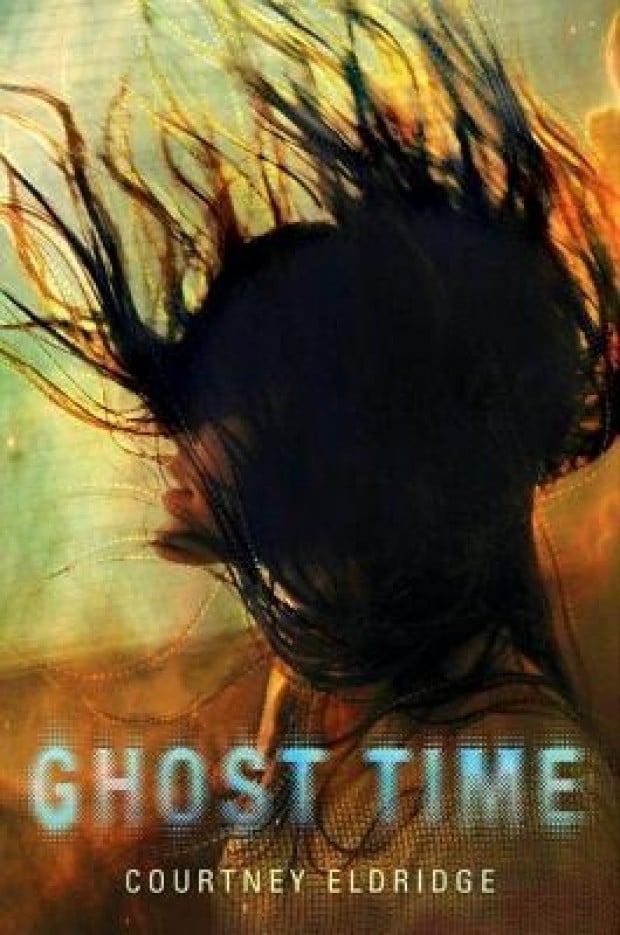
Double Review: Ghost Time - Courtney Eldridge

Ghost Time
Courtney Eldridge
Series: Saccades Project, #1
Genre: Young Adult, Romance, Science Fiction, Mystery, Paranormal
Rating: 4 out of 5 stars
Word Rating: Mind boggling
On Goodreads

I must admit, when I started reading Ghost Time, I was very put off by the writing style – I found Thea's shallow, valley-girl speech quite off-putting. However, as the plot progressed and we started to see some depth in Thea, I found myself more and more drawn into this story.

I received an uncorrected proof of Ghost Time from Amazon Children's Publishing at Book Expo America, and I was very excited to start it after reading the blurb – math-genius hacker, the voice of a mute girl, mysterious happenings... count me in! However, at the start of Ghost Time, the reader gets some of the prized dialogue that almost made me stop reading this book.
"It was cold, and I was just like, Brrrr!"
"...there was still a red outline of my lip gloss on his left hip bone, from when I'd knelt down, kissing him, because his hip bones drive me crazy."
"...and his bone structure, like his cheekbones, are to die."
" Because Cam has this really cool old car–it's so boss."
Ugh. Luckily, this shallow Thea didn't last too long, which gave way to her insightful side - a side that is much darker and deeper. The way Thea grows throughout the story is astounding. Gradually, the reader gains more and more information about Thea's past and her relationship with her missing boyfriend, Cam, as well as her new friend Melody, a girl who speaks to Thea in her head. Despite how she sounds at the beginning, Thea has depth that I'm not sure many 15-year-olds can understand. Throughout her life, Thea has been through many hard times, but even after Cam, a boy who taught her to see the world through a different light, disappears, she still does her best to stay strong and keep going. Thea was a surprising heroine for me. When I find a heroine I really love, it's almost always immediate, – I'm usually drawn in by her strength and general disregard for society – but Thea is completely different. Thea is weak, she cares what people think of her, she needs other people – she is a 15-year-old girl, a teenager thrown into a terrible situation. The way Thea survives throughout the story is truly heroic. No matter how bad things seemed, she kept going and hoping for the best.

And then there's Cam - who is, surprisingly, in very much of the book considering the fact that he is missing. Cam is probably definitely my favorite character in Ghost Time. While Thea may not be a scholar, Cam is very intelligent. The things he says to Thea are so insightful and captivating. Cam sees the world very different from most people, especially Thea, and he makes her see things differently. The title of the book, Ghost Time, comes from the equation that Cam is working on, regarding time moving in more than one direction at the same time. Courtney Eldridge does a brilliant job mirroring Cam's equation through the structure of the book, alternating between before and after Cam's disappearance. I love Cam. He is so loving and patient with Thea – it's kind of heart breaking. I wish there had been more Cam in Ghost Time – perhaps in Ghost Signs?

While most of Cam's appearances are from before he disappeared (obviously), Melody appears afterwards. Mel is the daughter of the cop who is investigating Cam's disappearance. While Mel is paralyzed and mute, Thea has strange visions of Mel's "true self" and hears Mel's voice inside her head. Mel is one of the only people who can make Thea forget about Cam and all the drama surrounding his disappearance. Although Thea’s past contributes to her growth in the eyes of the reader, her friendship with Mel augments this growth, allowing the reader to see a nurturing side of Thea. Thea will do anything to help Mel feel like a normal teenage girl. The way Thea takes Mel under wing makes their relationship so charming and heartwarming.

Overall, I really would have liked to give this book a higher rating, but the way Thea is portrayed in the beginning of the story just gets to me. When I compare the way Thea is in the first few chapters in comparison to the rest of the book, it's like she is a completely different character. I just don't see her being so different in the time lapses. Despite that, Courtney Eldridge crafted a wonderful novel filled with so many aspects of life: love, friendship, anger, sadness, family, longing – I could go on for a while. Even though I was skeptical about this book in the beginning, I'm glad I kept reading because the story was well worth it. The ending was very abrupt, leaving me asking, "WHERE IS THE REST OF THIS BOOK?!" but I'm hoping all will be resolved in Ghost Signs. The structure of the book along with the meticulous details, suspense, and insight made Ghost Time a great read.

Also, there's this cool thing: Saccades Project
Courtney Eldridge teamed up with some artists to gather inspiration for Ghost Time. It's really cool.

- Kiersten

Marlon's Ghost Time Review
Rating: 3.75 out of 5 stars
Word Rating: Incredible

Ghost time was absolutely miserable, the sort of miserable that one can only find after stubbing one's toe on a particularly blunt end-table and then promptly being made the live sacrifice to an Aztec sun god. While I agree that Deep Thea is a welcome distraction from the waterfall-of-consciousness writing style, and that bits and pieces of Cam spilling through the net of drama kept me going, this novel had a few too many disconnects and failings to warrant more than three stars.

Those three stars came from the impeccable construct of the book: Eldridge's seamless integration of scenes and story arcs is astonishing. Spoiler alert (but not really): the book successively runs scenes from both the future and past, each timeline splaying farther from the epicenter as the book progresses. Even at the beginning, this novel constantly blindsided me with this kind of construct. Each of Cam's stories grow from the insightful and intriguing bits they are into story-arc masterpieces in a matter of pages, simply because Thea connects it so bloody well.

Sadly it was not enough to save the rest of those tiny stars...

Seriously, "I was just like, Brrrr!" for the first hundred or so pages.

I absolutely despised Thea, who is undeniably a shallow bitch and yet somehow a deep, mysterious, and dark character whose love of music and media puts mine to shame . . . that didn't make sense at all. There was far too much of a disparity between the two sides of Thea. I'm not saying a deep character with a dark past should be foreboding and hesitant, of course, but only that someone who can see the world so much more vividly than the rest of us – with such a coursing imagination to boot and such a telling history – should at least make an attempt at maturity.

But no, what do I get? An insanely weak, angst-ridden annoyance that manages to represent the things I hate most: caring what other people think, selfishness and shallowness, and desperation.

And then, of course, I met Mel.

The most powerful connection in the book came to me when Thea first sees a ghost-like version of Knox's daughter, Melody. I thought back to the first few pages: "What if God was a teenage girl?" I was reflecting on what Melody had wanted from life, speculating on the insight and quality she could add to the story. I mean, after having to deal with a shallow teenage girl archetype that was a falsity, I was having a bit of a trust issue with this book. Shortly after, I realized that maybe Thea was the god of the situation. The simple fact that annoying-prissy-ugh Theadora was seeing things that shouldn't exist started to make her a tad less annoying-prissy-ugh, which coincidentally made reading a whole ton easier. (Would it KILL you to use quotation marks?)

And then Hubble started shifting reality and this book just kept getting freaking cool.

Honestly, that's my best description after this book picked up: freaking cool. The insights into reality (such as Thea's Balloon World bit) are to die for. And, for some reason, Melody brings out the kind of Thea that is slightly more enjoyable: deeply caring and concerned and giddy. All of the positive qualities Thea possesses seem to have been bottled up on a shelf for a good third of the novel, but when she begins to open up to Mel and, more importantly, the reader, she truly allows us to see what it's like to be her: the constant war of the world Cam has opened for her and the pressures of her past.

Also there's a climax and end but Kiersten's got that bit covered. Where is the rest of this book? It just dropped, in the middle of a scene.

In all, 3.75 stars, for dazzling construction and insight sorely missed by common eyes. Too bad the narration takes days to get used to and is absent entirely of everything this novel comes to represent.

- Marlon

How would you feel if your best friend just went missing?
Let us know in the comments!

Sunday, June 2, 2013

So I Met Brandon Mull

Literally rapt.
Just minutes before his book signing at BEA 2013. If you stare long enough you will notice that I am in the picture,
touching Brandon Mull . . .
breathing the same air as the person who penned the Blind King into existence.
What . . .


I would paint this picture upon every ceiling I ever call home if my artistic skills went beyond shoddy stick art.

But anyway . . .

Prior to that moment I had promised myself I'd treat the celebrities of my life as people and not the images and impressions of them that we develop that so often mislead and constrain us.

Unfortunately, upon walking up to him, every atom in my body shaking quite a bit more than usual, I totally exploded inside. Somehow I managed to contain myself with words I hoped were enough. I told him simply with all the grace of a slab of dog food, "thank you."

I meant every letter. Mr. Mull, if you ever happen upon these words, know that your mind has truly been a gift to me, one I hold just inches from my heart.

Back to the past: I smiled as wide as I think I ever have on the onset and far after our bit of dialogue. Around halfway through I had to look back at my best friend, gesture to myself and say, “definition of rapt,” (kindof a reference to Macbeth at the time but not entirely) which brought a laugh out of him and by consequence almost causing me a sudden dose of unconsciousness by way of fainting.

He asked me what I'd read of his, and I told him (The Candy Shop War, Fablehaven, and Beyonders series), and he said something along the lines of “oh, you're dedicated!” And I was. He then told me about a new series he was working on and I don't think I will ever forget how fantastically human he seemed (and was) when he gazed up up, fingers to his chin, the light catching his eyes, and said “hmm” while describing the series, which was to be five books.
     
That moment brought him down to earth for me but damn I was still breathless.
     
I relayed to him I was off to London in the fall – probably forgot to mention it was for a year – and that I'd written a novel and three quarters of another, but I never really got to tell him how exactly he changed my life because I'd love to credit him with giving me my love for books or something huge, but really, it was a new pair of eyes into the depth of an adventure, how words could curl so fluidly into one another and spin a tale that seems so blindingly deep you can't help but feel dizzy.
     
Immediately then I caught how important it is – that magical moment when you realize someone who has changed your life isn't just books and words, but flesh and blood. And I told him “It's staggering to know you're so much more than words.” And he thanked me, and smiled that wonderfully regular-guy smile in his red flannel (I think it was a red flannel) and I moved on with my day ( a Niel Gaiman was next) as if I had been struck by lightning.

- Swordfish Horski
(Marlon)