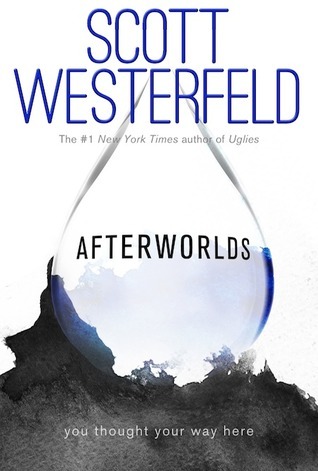
Afterworlds
Scott Westerfeld
Series: N/A
Genre: Young Adult, Fantasy
Release Date: September 23rd, 2014
Rating: 4.5 out of 5 Stars
Word Rating: Well.
Goodreads |
Amazon |
Book Depository
I'll spare you the primal, guttural affections I have for Midnighters, Leviathan, and Westerfeld's other works. Suffice it to say that he's a significant part of my introduction into YA. I'll spare you how much I loved meeting him at BEA, where I got a copy of this book.
Let's get to it, then.
Afterworlds is a pair of books that are laced together into one. The first follows, Darcy, a lucky writer learning the ins and outs of the publishing industry and of being independent. She's written a novel called Afterworlds about Lizzie, a girl who's also growing up, but in a different world, full of death and alienation. While these worlds are wildly different at first, they begin to reflect and respond to each other as the protagonists realize the truth behind their worlds and themselves.
As is obvious from the reviews that have already piled up behind this book, this one's pretty contentious. From the layman reader to the average YA lover to those nitpicking literary critics, those who’ve read Afterworlds seem either to love or hate it, for some combination of several reasons. (For a description/analysis of these reasons, scroll down to Noor's review). For a full-on, guns-ablazing break down of the major and minor "pitfalls" that other reviewers often cite, head over to this review.
Anyhow, enough of that.
I love love love love love this book.
The greatest thing about Westerfeld, I think, is his flexibility and the depth of his literary understanding. Take an honest once-over at Uglies versus Leviathan versus Afterworlds. Have they anything conceptually in common? Barely scraps — they may well have been penned by entirely different authors, yet all of them have been well-received. This aspect of his writing makes itself quite clear in this novel, where one novel had to seem entirely realistic and the other had to seem as if it were penned by a debut author, and Westerfeld definitely succeedes.
For example, Westerfeld's wit, his humor, and his gorgeous language is portrayed in two very different ways. One is highly polished - the language in Darcy's world is totally realistic. I've seen a lot of reviews point out that that people don't really speak in the profane manner that the characters do in Darcy's world, and to those people I say - have you ever talked to anyone . . . ever? Even novelists, who some reviewers seem to hold on this pedestal where they can only speak in the intelligent cadence of veteran lit-crits, are human and speak with a societal tongue. Then there's Lizzie's world, where really florid language is perfect and having a guy kiss you while you're in the throes of trauma is totally cool. I think such a contrast is so hard to do unless you're just really freaking good at writing, because you have to understand what naive writing is and what polished writing is and be able to write both. Westerfeld's is a dizzying kind of genius.
I loved watching Darcy plummet down the rabbit hole, through her first real relationship, through her re-writes, through her education on the publishing world - it's amazing watching something unfold when you're so interested in it. In addition, Lizzie's story, while falling rather flat (which is exactly what it’s supposed to do) content-wise, serves to showcase Darcy's growth and what she considers growth versus what she had initially envisioned in Lizzie's growth.
Unlike most people, I took to Lizzie's world, because it's so good sometimes, and sometimes so bad. For example, when Lizzie first wakes up in the afterworld, after having watched hundreds of people die and almost die herself, she is in a mist and believes she might be in heaven, which is a fascinating insight into the character . . . and then a few lines later she thinks to kiss the hot death lord she meets. This instance is an exaggeration, of course, of YA romance trends, and Westerfeld employs this unrealistic storytelling quite well. What’s even better is watching Darcy struggle with the problems in Lizzie’s emulating the struggle most writers have - between tropes and trends and individuality, for example.
I think readers often get caught up in the image of an author being totally solitary and working in the dark until finally - aha! - they've finished a piece of work. Westerfeld shows us, through Darcy, that most authors must be dreadfully aware of the current literary trends, everyone's viewpoints, his/her own voice, and a billion other anxiety-inducing things. As an experienced writer, Westerfeld masterfully gives us first a world that examines the pitfalls of an industry and an art form that Westerfeld has been part of for many years. He is highly critical, revealing the condescension of some writers in Darcy's world - they call Darcy's work "better than the average YA" for example -along with the many pitfalls of Lizzie's story.
I did have a few problems with the book, but they were mostly personal and did not really change my literary appreciation. These problems include wanting less Lizzie because I was more interested in Darcy's story but also finding Darcy rather unrelatable. I like Darcy's character, don't get me wrong. Westerfeld paints a very natural picture of a young aspiring artist: Darcy's anxiety manifests itself constantly - there must be a thousand references to that "fluke" she wrote "last November"; her sexuality is not a platform or a stage, but rather it is just a part of her, just a fact, the same way her brown skin and her not-so-Indian culture are just facts about her. (I've seen so many people complain that Darcy is just "too white" despite being Indian. These people completely miss the point that "white" does not mean "American" or "western" and that Westerfeld satirizes this problem by having Darcy get away with cultural appropriation even though she's Indian. Damn . . . it's hard to stay away from the contentious parts of this book.). Anyway, I love Darcy, but because I desire to be a successful published writer, I am jealous of Darcy's problems and I tend to trivialize them. For example, when she complains about not being able to eat out every night, all I can think of is that she lives in a $3000/month apartment in NY and has picked up a $300000 contract on a book she still thinks she fluked. I definitely understand the need to make Darcy special - it's hard for most readers to read about "normal" characters. At least, that's what I'm told. In any case, I found myself only really caring when Darcy was in deep ish.
So buy the book! Or mug someone with a copy? Either way, enjoy!
- Marlon
Noor's Afterworlds Review
Rating: 4.5 out of 5 stars
Word Rating: Can you spell meta?
I love Scott Westerfeld. A lot. I have loved him a lot for a long time and he was one of the first YA authors I read. We go way back. So when I had the chance to get a signed ARC of this book at BEA and meet him, I was ecstatic and wanted to read the book the second I got it. Of course, I also got a buttload of other books so I didn't read it until now. So after a few months of anticipation, I am so happy to say Afterworlds was definitely worth the wait.
I think the book is hit-or-miss and you either love it or you hate it. I clearly fall into the love category but those that fall into the latter are either those who don't like ghosts/paranormal things, or those who didn't fully understand how meta the book was.
Seriously, it was like meta on top of meta with a layer of meta icing. Which I loved, of course. The book contained two stories, each told in alternating chapters. The first was about Darcy Patel, Indian-American high school student who wrote a novel during NaNoWriMo and is now getting it published and moving to New York. The other story is the book she wrote, titled Afterworlds, and about a girl, Lizzie, who falls in love with the Hindu god of death. Now, I read some other reviews of the book and a lot of people are commenting on how they didn't think the story with Lizzie was all that great and that it fell short and was too typical paranormal, with all the tropes and cliches that made them drop stars like flies. Except, in my opinion, the whole point is for the story to be just that. This is supposed to be Darcy's first novel, one she wrote in a month, no less, and not even the final published version, but the first draft. She's also an 18 year old girl, and I'm not saying that 18 year old girls are inherently cliche writers, because I don't believe that at all (I mean, I am an 18 year old girl and I have seen many who are phenomenal writers). I am just saying that the whole point of the book is that this is the book Darcy Patel wrote, not a book Scott Westerfeld wrote. The first time she meets the death god, Yamaraj, he kisses Lizzie. She spends her whole interaction with him focusing on his looks and his slight accent and his hair. For her, it is insta-love -- well, closer to insta-attraction, but you get the gist. And that's the whole point, or at least the point that I saw. It's supposed to be flawed and Lizzie is supposed to be a little annoying and not fleshed out enough and basically the story is supposed to be a very typical YA paranormal romance, even though all throughout the beginning we see it marketed as better than average and so atypical because woo death god and culture. I mean, just look at who's doing that marketing: her agent, the one who gets paid to make her book sell and say things about it that might not necessarily be accurate. I think the people who didn't like the Afterworlds novel part of the story saw it as a separate entity that Scott Westerfeld used his own ideas and writing skills to write, rather than as something he wrote through the lens of this young, naive protagonist. See what I mean about meta?
The stuff about it being trope-y and cliche being said, I actually liked that half of the book a lot. I thought it was a cute story and I loved seeing the way it intertwined with Darcy's own life and how she'd mention things about writing it or certain scenes and aspects in the real world and then we'd get to see how it played out in the story. It was really cool seeing the author of the book go through the whole process with the book, and made me appreciate the story a lot more, especially the little things I wouldn't have known without Darcy's part to accent it. It made me wonder how often, when I'm reading, certain phrases or passages are essentially an inside joke the author made with him/herself. But going back to the point about the story, I thought it was enjoyable and entertaining and something I wanted to read, not something I made myself get through.
And then we have Darcy's story, which revolves around her time in New York and how getting a book published is not as east as mailing them a manuscript and then having the rest done for you. Of course, she does have a lot of fun in New York, but it's also a lot of work, and she often makes bad decisions or messes up. A lot of people think the way the whole publishing aspect and industry are shown is too far-fetched, but as an 18-year old girl who has not published anything reading a book by a successful author who has published many books (a lot more than zero), I think Scott Westerfeld is a lot more qualified to write about the publishing industry than I am to comment on it. I honestly really liked that it was a little over-the-top, because who wants to read about sitting at a desk and editing the same paragraph for an hour and then emailing a bunch of people and then more emailing and yay, paperwork (Is that what it's really like? That doesn't seem like it'd be too off base). If you can read a series about a wizarding school or a book about a girl narrating from heaven and utilize enough suspension of disbelief to go along with whatever is happening in the story, you can get over the fact that Darcy went to a bunch of parties and met a few eccentric people while getting her book published.
Not only do I love how self-aware this book is, but also how Scott Westerfeld uses his narrative to point out a lot of things problematic with authors and media in general. For example, even though Darcy is Indian, she grew up as an average American teenager, and refers to Hinduism as "her parent's religion." In her novel, she takes some of the mythology from the Scriptures and then alters it to fit her plot. She even changes some of the fundamental aspects of Yamaraj himself. At one point, she's called out on altering a religious text for "purposes of YA hotness." She feels uneasy about this and the person she's talking to points out that it's okay because she's Indian and it's her own text she's altering. The reader is meant to understand that this is a flimsy excuse and to consider Darcy's identity and question whether or not the idea really is problematic or not. She also comments on how Yamaraj is centuries old and wonders if it's weird, to which a fellow author tells her that it's all fine as long as he looks like a teenager. This is something commonly seen in YA books that Westerfeld pokes fun at and that I really liked. There's also the fact that Darcy explains how she made Lizzie white so anyone reading could fill themselves in her shoes and that it wouldn't be her fantasy (her as in Darcy) but that it could be anyone's. I just really enjoyed all the sly commentary Westerfeld provided in just these scene of dialogue and interacting with other authors. Westerfeld himself, by publishing this book, is releasing a book with a nonwhite, nonheterosexual protagonist which is pretty cool and rad.
So, to recap: Scott Westerfeld writes beautifully, his book is hella fab, and it's so meta that it hurts a little. Read it, please. It'll rock your socks.
-Noor
What's your favorite paranormal being to read about?
Let us know in the comments!